
IPS e.max lithium disilicate crowns
The gold standard in all-ceramic esthetics. IPS e.max by Ivoclar Vivadent delivers up to 400 MPa of flexural strength alongside natural fluorescence and translucency that no other all-ceramic system has matched.

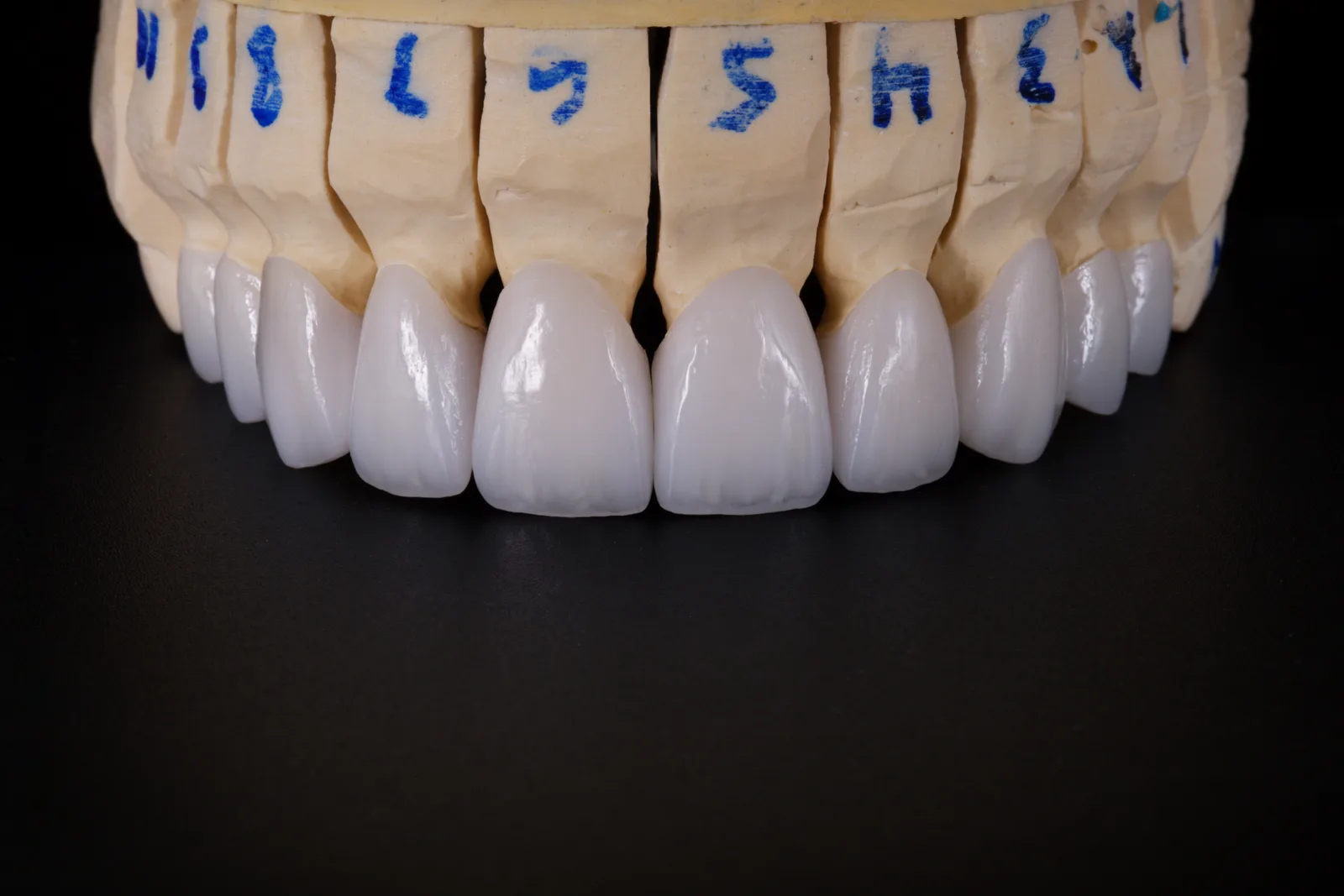
Strength meets lifelike esthetics.
We fabricate every e.max restoration by lost-wax pressing (IPS e.max Press) — the route that produces the most esthetic result, with optimal surface texture and natural light interaction. Pressed ingots give us full control over translucency and internal characterization that milled blanks can't match.
We match the correct ingot translucency (HT, LT, MO) to each clinical situation, cut-back and layer with Ivoclar Ceram where additional depth is required, and glaze to a natural finish.
Related all-ceramic services
e.max crown FAQ
Common questions from referring dentists about IPS e.max pressed lithium disilicate.
When should I prescribe e.max instead of zirconia?
IPS e.max is lithium disilicate — it carries real strength, but what sets it apart is the translucency and chameleon effect anterior work depends on. That makes it our first choice for veneers, inlays, onlays and single anterior crowns that have to disappear next to natural dentition. Zirconia leads when strength leads: posterior crowns, long-span bridges, implant frameworks and heavy function. If a case is anterior and high-load, send the occlusal details and we’ll talk it through before we press.
How should I cement an e.max restoration?
Lithium disilicate is designed to be adhesively bonded, and that bond is part of where the finished restoration’s strength comes from. We deliver every e.max case already etched — you silanate chairside and seat with a resin cement. Adhesive bonding matters most on veneers, inlays, onlays and any thin or less-retentive prep.
How much reduction does an e.max restoration need?
For crowns and onlays we ask for 1.0 mm minimum. For veneers, Ivoclar’s published minimum is 0.3 mm, but we’d rather have about 0.6 mm to work with. Stump shade drives this more than anything — on a darker prep, 0.3 mm often isn’t enough ceramic to mask what’s underneath and still land on a lighter target shade. If you’re masking discoloration, send the stump shade along with the target shade and we’ll tell you how much room we need.
Is e.max strong enough for posterior crowns?
IPS e.max Press has an average biaxial flexural strength of 470 MPa (Ivoclar Scientific Report, Vol. 42), which handles posterior single units well when there’s adequate reduction and a proper adhesive bond. It isn’t zirconia’s 1,250 MPa, so for molars in heavy function, long-span bridges or confirmed bruxism we’ll steer you toward PureZi. For any ceramic restoration in a confirmed bruxer, we recommend pairing the case with a nightguard.
Can I send a digital scan instead of an impression?
Yes. If your scanner supports it, add GIE as a connected lab and send cases straight from your portal — see connect your scanner. If your system isn’t supported, upload STL or PLY files directly through send your scan files. Conventional impressions are also accepted — call and we’ll send a FedEx label for pickup.